Anti-predator adaptations 🦋
Every organism on Earth is motivated by one ever-important goal — pass on as many genes as possible to the next generation. Of course, to accomplish this, you must survive. How is prey meant to survive when there's so many other organisms looking for their next meal?
Prey can fight back. Not just through physical means, but on an evolutionary timescale. Those that develop chance mutations allowing them to survive predation pass on more of their genes, and these traits will eventually propagate throughout the entire population by way of natural selection.
Click the images on the right to explore some examples of anti-predator adaptations.


Crypsis 🌳
Crypsis is the ability of an organism to blend in with its surroundings. It is a specific type of camouflage.
Crypsis is commonly visual (cryptic coloration), but can also be olfactory or even auditory. For many organisms, crypsis involves blending in with vegetation such as trees, grass, or leaves. The goal here is to go completely unnoticed by melding with the background of the environment.
This strategy is often just one part of more complex predator-avoidance behavior, and is frequently accompanied by specific patterns of activity such as habitat choice that lead to more effective camouflage for the prey.
This method is also frequently employed by predators, who may wish to blend in with their surroundings in order to sneak up on unsuspecting prey.
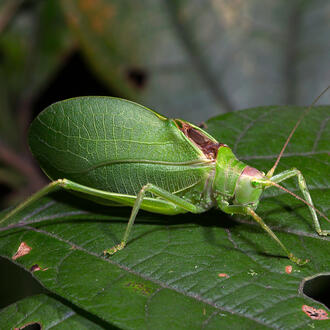
A katydid (Pterophylla camellifolia), which blends in easily with leaves due to its coloration and patterning
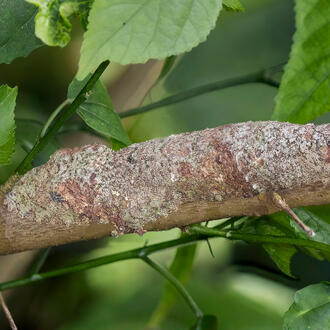
A mossy leaf-tailed gecko (Uroplatus sikorae), nearly indistinguishable from moss on a branch
Masquerade 🪨
Masquerade is the ability of an organism to appear as an inedible object. It is a specific type of camouflage.
Masquerade differs from crypsis in that the prey is expecting to stand out and be seen by the predator, but hopefully also be ignored. This relies at least partially on predator cognition (in that the predator is expected to mistake the prey as an inedible object). It is one of the more widespread anti-predator adaptations, but is less studied than others due to difficulty in testability.
The efficacy of this method increases in empty areas on visually contrasting substrate, the opposite of where crypsis would be most effective.
There has been debate in the field as to whether this strategy is more accurately classified as just another type of crypsis or as Batesian mimicry, but there is now a general consensus that masquerade is its own distinct strategy.
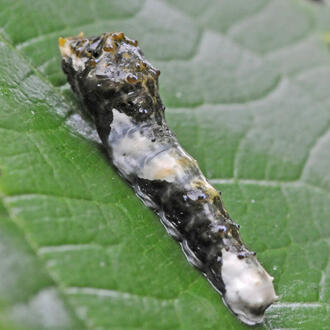
A giant swallowtail (Papilio cresphontes) caterpillar, which appears strikingly similar to bird droppings
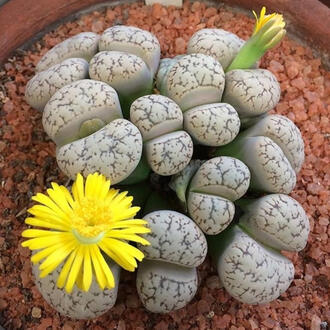
Lithops (Lithops werneri), a genus of succulents that look just like rocks, with varying patterns based on environment